
Startup tagline examples, and how to write your own
Startup tagline examples from real products like Stripe, Plausible, and Tally, what they have in common, and a five-minute method to write and test your own.
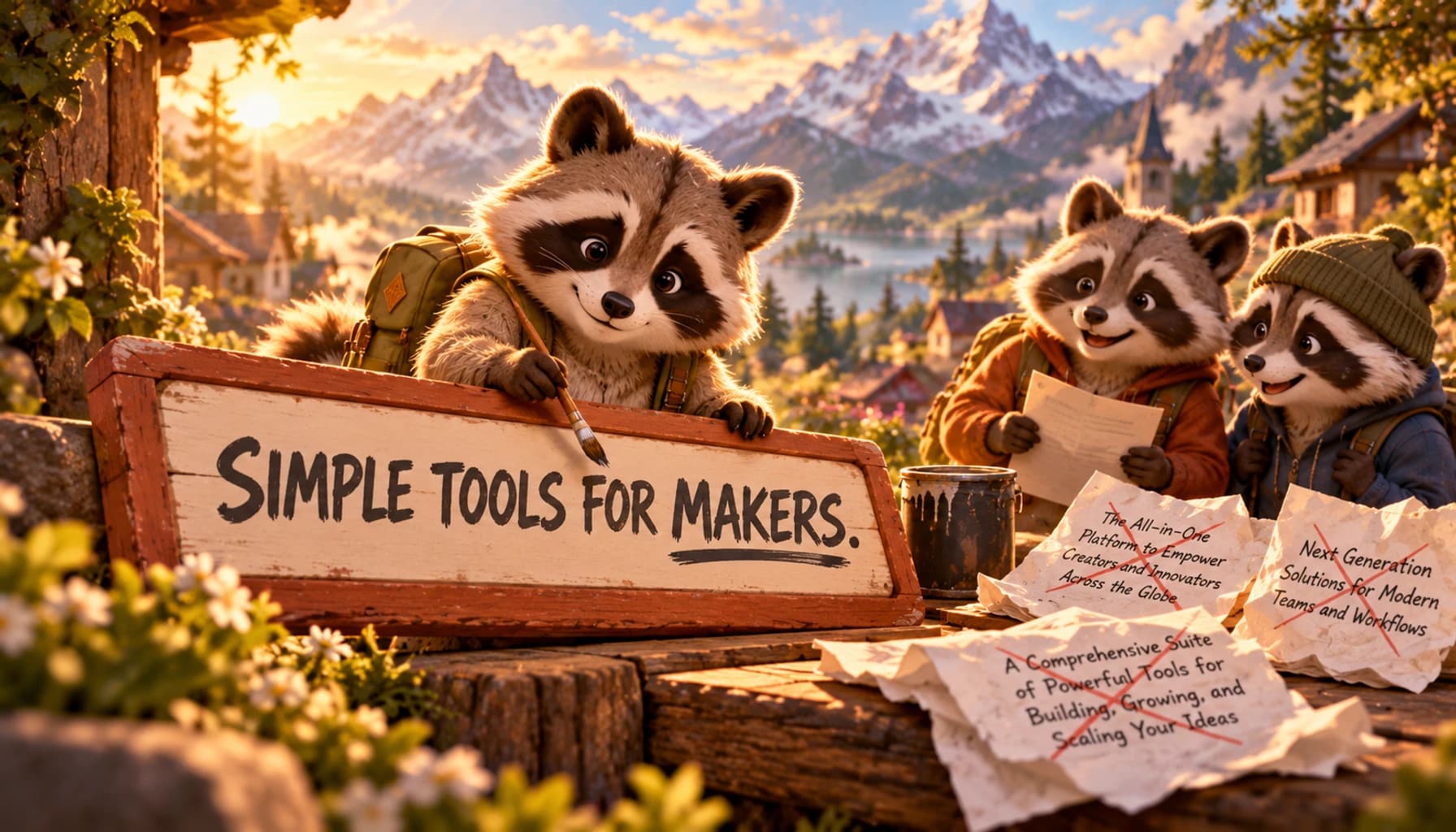
The best startup tagline examples answer two questions in one line: what does it do, and who is it for? Plausible says “privacy-friendly Google Analytics alternative”. Tally says “The simplest way to create forms”. Write ten versions with the pattern “[outcome] for [specific buyer]”, keep it under 60 characters so it fits Product Hunt and DanielLaunches, and test it on five strangers.
The startup tagline examples worth copying all do the same thing: a stranger reads one line and knows what the product is. Clever comes second, if at all. Below are real taglines from well-known products, what makes them work, and a short method for writing your own.
Startup tagline examples from real products
Each line below is taken from the product’s own homepage, checked on 18 October 2026. Taglines change often, so treat them as snapshots.
| Product | Tagline on its homepage |
|---|---|
| Plausible | Easy to use and privacy-friendly Google Analytics alternative |
| Tally | The simplest way to create forms |
| Carrd | Simple, free, fully responsive one-page sites for pretty much anything |
| Stripe | Financial infrastructure to grow your revenue |
| Buffer | Social media management for everyone |
| Linear | The product development system for teams and agents |
| Calendly | All the work around meetings, handled. |
| Loom | One video is worth a thousand words |
- ProductPlausible
- Tagline on its homepageEasy to use and privacy-friendly Google Analytics alternative
- ProductTally
- Tagline on its homepageThe simplest way to create forms
- ProductCarrd
- Tagline on its homepageSimple, free, fully responsive one-page sites for pretty much anything
- ProductStripe
- Tagline on its homepageFinancial infrastructure to grow your revenue
- ProductBuffer
- Tagline on its homepageSocial media management for everyone
- ProductLinear
- Tagline on its homepageThe product development system for teams and agents
- ProductCalendly
- Tagline on its homepageAll the work around meetings, handled.
- ProductLoom
- Tagline on its homepageOne video is worth a thousand words
What the best startup taglines have in common
- They name the category. Forms, one-page sites, social media management, analytics. A buyer recognizes the job before they finish reading.
- They define themselves against something known. “Google Analytics alternative” tells you the product, the competitor, and the reason to switch in four words.
- They make one promise. Tally promises simplicity. Plausible promises privacy. Neither tries to list every feature.
- They name a buyer when it helps. “For teams and agents” and “for everyone” both narrow or widen the audience on purpose.
Loom is the useful exception. “One video is worth a thousand words” does not say what Loom is, so its page title does that job instead: “Free screen recorder for Mac and PC”. A clever line can work for a known brand, but a new product launching to strangers rarely has that luxury.
How to write a startup tagline
Start from a pattern, then write at least ten versions. The useful phrasing usually shows up around draft six.
| Pattern | Example |
|---|---|
| [Outcome] for [buyer] | Get paid faster, for freelance designers |
| [Category] that [difference] | Uptime monitoring that texts you before customers notice |
| [Job] without [the pain] | Schedule client calls without the email back-and-forth |
| [Known product] alternative for [buyer] | A simple Mailchimp alternative for newsletters |
| The [adjective] way to [job] | The fastest way to turn podcasts into blog posts |
- Pattern[Outcome] for [buyer]
- ExampleGet paid faster, for freelance designers
- Pattern[Category] that [difference]
- ExampleUptime monitoring that texts you before customers notice
- Pattern[Job] without [the pain]
- ExampleSchedule client calls without the email back-and-forth
- Pattern[Known product] alternative for [buyer]
- ExampleA simple Mailchimp alternative for newsletters
- PatternThe [adjective] way to [job]
- ExampleThe fastest way to turn podcasts into blog posts
The best words come from customers, not brainstorms. Read your last ten customer conversations, support emails, and reviews of competing tools, and highlight how people describe the problem. If three people said “I just want to stop chasing invoices”, that phrase beats anything you invent, and it matches what buyers type into search.
Tagline length limits on launch platforms
Write to the shortest limit you will meet, so one line works everywhere:
| Where it appears | Limit |
|---|---|
| Product Hunt tagline | 60 characters |
| DanielLaunches tagline | 60 characters |
| App Store app name and subtitle | 30 characters each |
- Where it appearsProduct Hunt tagline
- Limit60 characters
- Where it appearsDanielLaunches tagline
- Limit60 characters
- Where it appearsApp Store app name and subtitle
- Limit30 characters each
Product Hunt also asks for “no gimmicks or over-the-top language” in the tagline. The Product Hunt guide covers the rest of that submission.
How to test a tagline in five minutes
- 1Show the name and tagline for five seconds to someone who has never seen the product. No logo, no screenshot.
- 2Hide it and ask: “What does it do?” and “Who is it for?”
- 3Repeat with five people. If fewer than four get both right, rewrite.
- 4Ask what they would search to find it. Their words are often a better tagline than yours.
Then check how it looks as a link. Many people meet a product in a chat or a feed before they visit, so paste your homepage into the OG image checker to see the card your tagline and image produce.
Startup tagline mistakes to avoid
- Abstract nouns. “Empowering teams to unlock potential” fits every company and describes none.
- Leading with the technology. “AI-powered” says how, not what. Lead with the job.
- Covering every use case. Pick the buyer you can reach first.
- Superlatives you cannot prove. “The best” and “the only” invite doubt.
If a launch gets clicks but the wrong people sign up, the tagline is one of the first things to change. Keep the old line and its numbers, so a relaunch compares honestly. Our guide to a stalled launch shows how to tell a message problem from a traffic problem.
Frequently asked questions
What is a good tagline for a startup?
One that says what the product does and who it is for in under about 60 characters, such as Tally’s “The simplest way to create forms”. Clarity matters more than cleverness when strangers see it for the first time.
How long should a startup tagline be?
Under 60 characters, which fits Product Hunt and DanielLaunches. Never cut the words that name the category or the buyer to save space.
What is the difference between a tagline and a slogan?
A slogan is a memorable brand line, like Loom’s “One video is worth a thousand words”. A startup tagline is a functional description. A new product needs the functional one first.
Should a tagline include keywords?
Include the category word buyers use, such as forms or analytics, because it helps people and search engines understand the product. Do not add more keywords at the cost of reading naturally.
Got your tagline? Put it in front of real visitors.
Launch on DanielLaunches and see the real visitors and clicks your tagline earns, on a permanent product page.
Get my roadmapRead next
Sources
- Product Hunt: Preparing for launch - the 60-character tagline limit and the guidance against gimmicks
- Apple: Creating your product page - the 30-character limits for App Store app names and subtitles
- Plausible Analytics - an example of a tagline that names a known competitor
- Tally - an example of a one-promise category tagline